By Sharon Kyatusiimire
October 25th, 2026
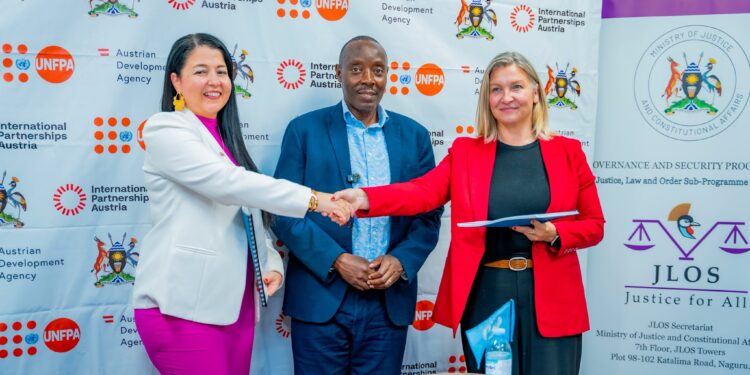
The government of Austria, the United Nations Population Fund (UNFPA), and the government of Uganda have signed a €3.42 million (approximately UGX 16b) agreement to expand access to justice, sexual and reproductive health and rights (SRHR), and gender-based violence (GBV) prevention and response services across Northern Uganda.
The agreement will fund the third phase of the Sexual and Reproductive Health, Access to Justice, Freedom, Equality and Rights (SAFER) Project, which will run from 2026 to 2029 and target 830,872 direct beneficiaries in the Karamoja, Acholi and Lango sub-regions.
Under the tripartite agreement, Austria will contribute €3.2 million, while UNFPA will provide €220,000 to support interventions targeting women, adolescent girls, persons with disabilities and underserved communities.
The signing ceremony, held at the Justice, Law and Order Sector (JLOS) Towers in Kampala on October 23, brings together the Austrian Government, UNFPA and the Government of Uganda under the leadership of the Ministry of Justice and Constitutional Affairs and the Ministry of Gender, Labour and Social Development.
The initiative builds on achievements from the first two phases of the SAFER Project, with a renewed focus on strengthening survivor-centred justice systems, improving access to essential health services and addressing the underlying social and institutional barriers that perpetuate gender-based violence.
Dr Katja Kerschbaumer, Head of the Austrian Embassy and Development Cooperation, said the funding reflects Austria's continued commitment to strengthening the rule of law and protecting vulnerable populations in Uganda.
“Through the SAFER programme, we are improving access to justice, addressing gender-based violence, and advancing sexual and reproductive health and rights in Northern Uganda through an integrated approach that brings together the justice, health, and education sectors to deliver more coordinated and sustainable outcomes,” Kerschbaumer said.
The project will strengthen coordination between justice, health and protection institutions to ensure that survivors of gender-based violence can access timely, dignified and comprehensive support.
UNFPA Representative in Uganda Kristine Blokhus said the programme would prioritise integrated services that respond to the needs of survivors while strengthening the institutions responsible for protecting their rights.
“By streamlining integrated health, justice, and protection services, UNFPA is committed to ensuring that every survivor of gender-based violence receives rapid, dignified, and survivor-centred support,” Blokhus said.
She also expressed appreciation to the Austrian Government for its financial contribution, noting that the partnership would help expand access to justice and essential services for women and girls in Karamoja, Acholi and Lango.
Robert Kasande, Permanent Secretary in the Ministry of Justice and Constitutional Affairs, said access to sexual and reproductive health services was also a matter of human rights, dignity, equality and justice.
He reaffirmed the ministry’s commitment to working with Austria, UNFPA and other government institutions to strengthen coordination, improve access to remedies and ensure that the programme produces measurable results.
Kasande said the project’s success would depend on the ability of participating institutions to translate the agreement into tangible improvements in people’s lives.
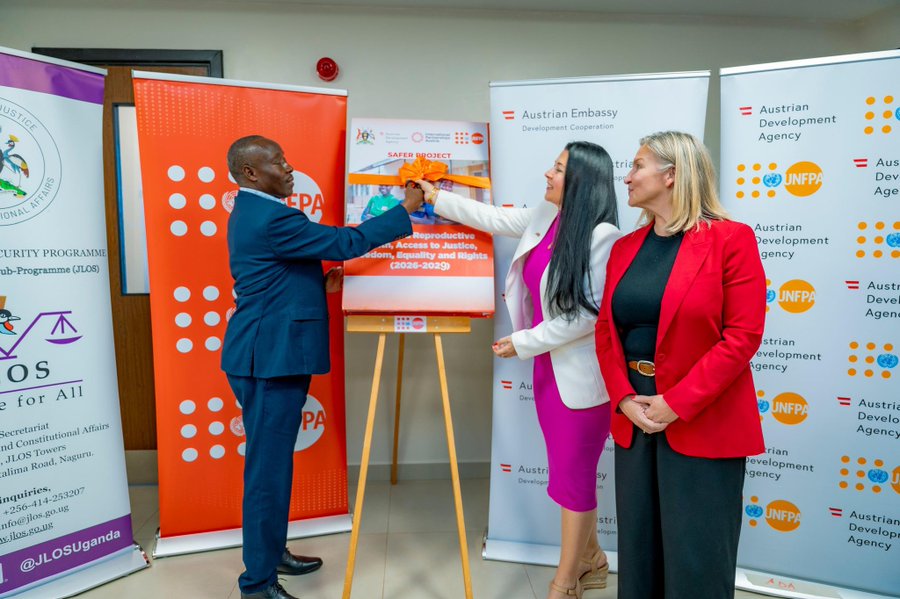
Implementation will involve key national institutions, including the Office of the Director of Public Prosecutions, the Uganda Police Force, the Uganda Prisons Service, the Uganda Human Rights Commission and Local Council Courts. Civil society organisations, including the Uganda Women's Network (UWONET), will also support the initiative.
Over the next three years, the programme will scale up access to comprehensive sexual and reproductive health services, strengthen GBV prevention and response mechanisms, and expand access to legal assistance for vulnerable populations.
It will also support institutional capacity-building to improve access to justice, including efforts to reduce case backlogs through special court sessions and appropriate alternative dispute resolution mechanisms.
Beyond formal justice systems, the SAFER Project will address harmful practices such as female genital mutilation and child marriage, while responding to emerging forms of violence, including technology-facilitated gender-based violence and economic exploitation.
The programme is aligned with Uganda's Fourth National Development Plan (NDP IV) and seeks to strengthen existing national systems to ensure that interventions remain sustainable beyond the project's implementation period.
By embedding its activities within established government institutions, the initiative aims to improve coordination, strengthen accountability and create more accessible systems for communities seeking justice, healthcare and protection from violence.
The third phase of SAFER comes amid continued efforts to address barriers that prevent women and girls in underserved communities from accessing essential services and exercising their rights. Its success will depend on effective coordination among government institutions, development partners and civil society, as well as the ability to translate funding commitments into accessible services for the communities targeted by the programme.
Sharon Kyatusiimire
Co-Founder & Executive Director, She-Voice Uganda. Gender Responsive Reporting and Communication Trainer, Journalist, Public Relations specialist, Content Developer, Women Empowerment Activist.